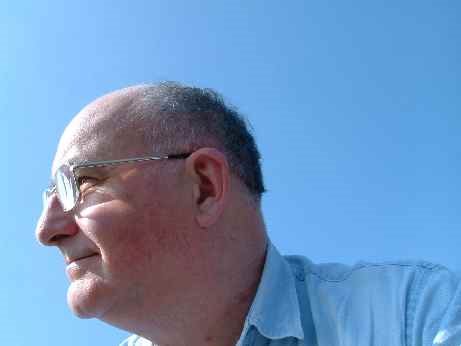
Another good walk yesterday, this time with about 50 assorted Bristol Living Rivers supporters from Sea Mills, where the River Trym joins the Avon. We hiked upstream into Westbury where the Trym is joined from the North by the Hazel Brook, sometimes known as the Hen Brook which we then followed as far as its emergence from drainage pipes near the huge shopping centre at Cribbs Causeway.
My photos on Picasa tell the tale - but just to explain the gravestone in Henbury Churchyard! The boy was one of many young african slaves who had not been sent to the sugar cane fields of the West Indies or the Cotton Fields of America but was chosen to be a servant in the household of Bristol nobility. It seems he was treated well, though he must have been the object of much curiosity and novelty at the time.
Sponsor a Child with Plan, I do!

Monday, June 04, 2007


Thursday, May 24, 2007
The Dragon flag flies on the top of the World

Congratulations to Tori James who has just climbed to the summit of Mount Everest 8,848 meters above sea level. She is a fellow member of the British Schools Exploring Society and is climbing with a team from the London School of Business. At 23 she is the youngest female Briton and first Welsh woman to have successfully made it to the top.
Wednesday, May 23, 2007
The Father of Taxonomy


He's more influential than ABBA, more famous than Bjorn Borg and Sweden is celebrating today the 300th birthday of its most illustrious son: Carl Linnaeus, also known as Carl von Linné or Carolus Linnaeus. He is often called the Father of Taxonomy. His system for naming, ranking, and classifying organisms is still in wide use today and his ideas on classification have influenced generations of biologists during and after his own lifetime. His signature plant the Twin Flower, Linnea Borealis is to be seen in paintings of him as shown above.
This year's Chelsea Flower Show in London has a Linnaeus feature garden and Sweden's University of Uppsala, his alma mater, is holding various celebrations.
How times have changed!

Sorry about the quality of this but it is a genuine extract from a British sex education textbook for girls printed in the 1960's. Click on it to enlarge so as to read it easier! In the last paragraph I am wondering what the girls who read this originally thought their future husbands might have suggested in the line of "unusual practices"! I reckon there would have been a few giggles in the classroom!
Sunday, May 20, 2007
The Brislington Brook


Bristol like many British cities has grown over the centuries and many villages formerly outside the city walls have been subsumed into the whole and are now the kind of suburbs to be seen anywhere in the country. However on close inspection of the map there is parkland and wasteground between many of the built up areas. Often these "between" areas follow streams and are havens for both plants and animals.
Today's walk was through an area of Bristol that I do not know well and about 30 of us met near the southern edge of the city at Whitchurch to walk down the route of the Brislington Brook as far as St Anne's a Victorian parish church on the site of a much older monastic building and place of pilgrimage in times gone by.
As usual with these walks we were given full explanations of the history of the area and any buildings of note were pointed out and their names explained. For example a side street pub we passed called The Pilgrim Inn was named so, because it was on the regular route taken by pilgrims walking to St Anne's Well, including King Henry VII who visited twice.
Sometimes we were traipsing though quite long grass and plant cover, at other times on well used woodland paths but mostly we were oblivious to the busy roads beyond and to either side of the Brook. The second photograph shows a magnificent but weary old Plane tree, standing by the brook in Nightingale Valley.
Busy on the rocks


Saturday Night
I've been busy! This weekend I have three field trips planned. Two are complete and the third will start at 10am on Sunday morning.
The first which was organised by the West of England Geologists' Association, was to a huge, now disused limestone quarry on the English side of the River Wye in Gloucestershire. Our leader Nick Chidlaw chose a bright and breezy clear day to take us to see some spectacular scenery and interesting rock types and stratigraphy.
The trip finished for me at about 5:30pm though some soldiered on to one more terrace above that on the second photo. I drove back to Bristol to have a short break before field trip number 2.
This evening, I met fellow members of the Avon Bat Group and some public visitors for a "Bat Walk" in Leigh Woods to the west of the River Avon at Bristol. There was a good mix of people, adults and enthusiastic children, enjoying a sometimes led by torchlight walk through the woods. Several bats, mostly Common and Soprano Pipistrelles were seen and heard on Bat Detectors and there was a possible sighting of a Serotine Bat flying low in one of the clearings. It is still a bit early in the season for bats and this was the first organised walk, but the Bat Detectors where chirruping away with bat sound. By the time of the July walk there will be many more flying, though of course dusk will be much later. On our way back there were great views over Bristol by night and of the cresent moon, accompanied closely by the cresent planet Venus. Sadly no camer and tripod at the time!
Tomorrow - another trip - this time another Bristol Living Rivers Project walk this time down the Brislington Brook. - I will write on that after the event I hope!
Wednesday, May 16, 2007
Wine, women and song!

Yesterday I really enjoyed the concert at St George's Bristol where Gretchen Peters (above), Suzy Boggus and Matraca Berg were peforming their first booking of the latest UK tour. The wonderful accoustics of the former church, together with three wonderful singer-songwriters and an appreciative audience resulted in a great evening. These Nashville ladies were clearly enjoying themselves and recieved a well deserved standing ovation at the end.
Monday, May 14, 2007
My Antarctic Photo of the Day

The weather has been awful this weekend. Lots of rain, so the farmers will be happier but not so good for getting out into the countryside. So back to South Georgia! - King Penquins en garde!
Saturday, May 12, 2007
Plea to Japan

I have said it before and no doubt I will need to say it again, but I would like to voice my concern about the future of whale conservation. In a few day's time Japan will once again try and get enough support from other members of the International Whaling Commission in order to rescind the 25 year old moratorium on commercial whaling. The IWC are meeting in Anchorage, Alaska this month and concern is mounting. The moratorium has been openly flouted as this photo shows only too graphically.
The whale meat trade in the far east is in my opinion totally indefensible, Japanese Kobe beef is wonderful, as is beef from many other countries including my own and like it or not, cattle are farmed sustainably for this purpose. But whales are still an unsustainable resource and though there has been some recovery, many species are still endangered and will be more so if commercial whaling resumes. I have been to watch whales, and have been privileged to see them enjoying the freedom of the oceans on several occasions. There is income to be derived from all the tourists who want to see the whales and I urge Japan and all the other whaling Nations to think about converting their whale catching and harpooning ships to scrap and concentrating on the world benefit of seeing and photographing whales for generations to come.
Monday, May 07, 2007
Benighted Benin

Here in Bristol this year we are celebrating the 200th anniversary of the abolition of slavery. There are fascinating exhibitions and linked events here, but in far away West Africa slavery still exists. Evil people are still carrying on exploiting children as young as five years old. Plan UK have just sent me their latest e-magazine and it makes chilling reading as nothing seems to be able to be done to stop the traffickers, such is the criminal power that they wield as soon as the authorities try to move in. Well done Plan for bringing it to my attention - I am powerless to do anything, but at least I can tell my friends. This little Benin slave girl Afi is just 9 years old.
Saturday, May 05, 2007
The Shelduck Ordeal


I was amazed this morning on an excellent walk organised for members of the Bristol Ornithological Club [BOC] to the Gordano Valley. What caused my amazement was the sight of nine Shelduck in a field on Weston Moor, 2 or 3 kilometres from the sea coast which is their usual habitat. Well not so much the sight, as they can fly anywhere, but the tale we were told: They like nesting in the willow thickets near to one of the many rhynes (drainage ditches) in this area of relative safety for them. However once the ducklings are old enough and long before they can fly, they have to be led by their mothers from their nest sites, over several fields, over two roads and over a hill to reach the coast and they walk the whole way. Have a look at the map! There is a public footpath [the red dashed line] marked on the map from Weston Moor, it goes Northwestward across the B3124 road towards Walton Bay in the Severn Estuary, but most ducks of my acquaintance anyway, can't read maps or road signs!
Thursday, May 03, 2007
Best Stories of Childhood -

I was discussing earlier with a friend our best remembered and loved childhood stories. In England I think I am right in saying that Antoine de St Exupery's "The Little Prince" is not as well known as it should be and I introduced to her "The Colour Kittens," a little tale by Margaret Wise Brown and ilustrated by Alice & Martin Provensen that in my family, entranced several generations of children.
I expect my brother and his family has the copy that was in our parents' house from the 1940's on. It is still in print but I am going to stick my neck out and "privately" publish it here because I like it and so does every child of three years old going on seventy that I know. The Colour (Mostly on Google as Color) Kittens is a timeless and educational story of Hush and Brush so listen!
“Once there were two colour kittens with green eyes, Brush and Hush. They liked to mix and make colours by splashing one colour into another. They had buckets and buckets and buckets and buckets of colour to splash around with. Out of these colours they would make all the colours in the world.
The buckets had the colours written on them, but of course the kittens couldn’t read.
They had to tell by the colours. ‘It is very easy,’ said Brush. ‘Red is red. Blue is blue.’ said Hush. But they had no green. ‘No green paint!’ said Brush and Hush. And they wanted green paint of course, because nearly every place they liked to go was green. Green as cats’ eyes. Green as grass. By streams of water. Green as glass. So they tried to make some green paint.
Brush mixed red paint and white paint together - and what did that make? It didn’t make green. But it made pink. Pink as pigs. Pink as toes. Pink as a rose. Or a baby’s nose.
Then Hush mixed yellow and red together, and it made orange. Orange as an orange tree. Orange as a bumblebee. Orange as the setting sun. Sinking slowly in the sea. The kittens were delighted, but it didn’t make green.
Then they mixed red and blue together - and what did that make? It didn’t make green. It made a deep dark purple. Purple as violets. Purple as prunes. Purple as shadows on late afternoons. Still no green!
And then…
O wonderful kittens! O Brush! O Hush! At last, almost by accident, the kittens poured a bucket of blue and a bucket of yellow together, and it came to pass that they made a green as green as grass. Green as green leaves on a tree. Green as islands in the sea.
The little kittens were so happy with all the colours they had made that they began to paint everything around them. They painted… Green leaves and red berries, and purple flowers and pink cherries. Red tables and yellow chairs, black trees with golden pears.
Then the kittens got so excited they knocked their buckets upside down and all the colours ran together.
Yellow, red, a little blue and a little black…and that made brown. Brown as a tugboat, brown as an old goat, brown as a beaver. BROWN. And in all that brown, the sun went down. It was evening and colours began to disappear in the warm dark night.
The kittens fell asleep in the warm dark night with all their colours out of sight and as they slept they dreamed their dream - A wonderful dream of a red rose tree that turned all white when you counted three…One…Two..Three. Of a purple land in a pale pink sea, where apples fell from a golden tree. And then a world of Easter eggs that danced about on little short legs. And they dreamed of a mouse, a little gray mouse that danced on a cheese that was big as a house. And a green cat danced with a little pink dog, till they all disappeared in a soft grey fog.
And suddenly Brush woke up and Hush woke up. It was morning. they crawled out of bed into a big bright world. The sky was wild with sunshine. The kittens were wild with purring and pouncing - Pounce Pounce Pounce. They got so pouncey they knocked over the buckets and all the colours ran out together. There were all the colours in the world and the colour kittens had made them.
The buckets had the colours written on them, but of course the kittens couldn’t read.
They had to tell by the colours. ‘It is very easy,’ said Brush. ‘Red is red. Blue is blue.’ said Hush. But they had no green. ‘No green paint!’ said Brush and Hush. And they wanted green paint of course, because nearly every place they liked to go was green. Green as cats’ eyes. Green as grass. By streams of water. Green as glass. So they tried to make some green paint.
Brush mixed red paint and white paint together - and what did that make? It didn’t make green. But it made pink. Pink as pigs. Pink as toes. Pink as a rose. Or a baby’s nose.
Then Hush mixed yellow and red together, and it made orange. Orange as an orange tree. Orange as a bumblebee. Orange as the setting sun. Sinking slowly in the sea. The kittens were delighted, but it didn’t make green.
Then they mixed red and blue together - and what did that make? It didn’t make green. It made a deep dark purple. Purple as violets. Purple as prunes. Purple as shadows on late afternoons. Still no green!
And then…
O wonderful kittens! O Brush! O Hush! At last, almost by accident, the kittens poured a bucket of blue and a bucket of yellow together, and it came to pass that they made a green as green as grass. Green as green leaves on a tree. Green as islands in the sea.
The little kittens were so happy with all the colours they had made that they began to paint everything around them. They painted… Green leaves and red berries, and purple flowers and pink cherries. Red tables and yellow chairs, black trees with golden pears.
Then the kittens got so excited they knocked their buckets upside down and all the colours ran together.
Yellow, red, a little blue and a little black…and that made brown. Brown as a tugboat, brown as an old goat, brown as a beaver. BROWN. And in all that brown, the sun went down. It was evening and colours began to disappear in the warm dark night.
The kittens fell asleep in the warm dark night with all their colours out of sight and as they slept they dreamed their dream - A wonderful dream of a red rose tree that turned all white when you counted three…One…Two..Three. Of a purple land in a pale pink sea, where apples fell from a golden tree. And then a world of Easter eggs that danced about on little short legs. And they dreamed of a mouse, a little gray mouse that danced on a cheese that was big as a house. And a green cat danced with a little pink dog, till they all disappeared in a soft grey fog.
And suddenly Brush woke up and Hush woke up. It was morning. they crawled out of bed into a big bright world. The sky was wild with sunshine. The kittens were wild with purring and pouncing - Pounce Pounce Pounce. They got so pouncey they knocked over the buckets and all the colours ran out together. There were all the colours in the world and the colour kittens had made them.
Sing Ho for the colour of Brush. Sing Ho for the colour of Hush. Sing Ho for the colour of Brush and Hush. Sing Ho for the colour of colour.
Now hush!”
Wednesday, May 02, 2007
Language acquisition
 The Yerkes National Primate Center in Atlanta GA has come up with some interesting but not very startling ideas about the acquisition of language in early humans from study of the behaviour of Bonobos and Chimps. This week’s New Scientist carries the full article.
Human spoken language they postulate, may have evolved from a complex and varied set of hand and arm gestures, not simply through improvements in the basic vocalisations made by primates.
Bonobos and chimps both split from the line that led to Homo sapiens about six million years ago, and they themselves parted about 2.5 million years ago. However, several lines of evidence suggest we are slightly closer to bonobos than we are to chimps. De Waal says that their work suggests bonobos are a more useful species for understanding the evolution of language. For one thing, they seem to have moved further from the common ancestor, at least in terms of the complexity of their communication, than have chimps.
Tuesday, May 01, 2007
May Day Walk to Work

Sadly there are no Bank Holidays for us here in Britain this week. Next Monday we do have though! Quite apart from the fact that my car is sick and is in the garage being fixed, it was a lovely day to walk to and from work today. I took my camera and have uploaded my shots to Flickr - please take a look! I am very lucky to have such a green and leafy route to take with only the busy Bristol Ring Road to cross on foot at a badly marked crossing point! The University campus grounds with ponds and streams are well worth a short detour. The walk takes me about half an hour and I really should do it more often!
Tuesday, April 24, 2007
My Photo of the Day
 The Roman Bath in the city of Bath, just 8 miles away from Bristol. There is a new spa centre just outside this building, the Thermae Bath Spa which has cost millions of pounds to complete and is proving very popular. The natural spring that provides the water emerges at a hot 47 degrees Centigrade - [see link above] but I would not reccomend drinking too much of it!
Monday, April 23, 2007
St George's Day
 Patron of many but little is known! Today April 23rd, is St Georges Day, the Patron Saint of England, but widely ignored by most of my fellow English. I suppose the majority have heard of him, “he killed the dragon, didn’t he,” but few know more than that and it is to some, a shame that a public holiday on this day is not celebrated.
In researching this little article I have found the excellent website of Woodlands Junior School of Tonbridge in Kent and I commend it to you dear reader! The Wikipedia article lists all the patronages of our Saint, but to raise an eyebrow or two here are a few of his many!
Scouts; butchers; farmers; Bulgaria, Greece, Germany; Genoa and Moscow; saddle makers and syphilis sufferers; archers and shepherds; horses, sheep and lepers.
Tuesday, April 17, 2007
Flightless Steamer Duck
 My blog is now over one year old and in celebration of this here is my photo of a Flightless Steamer Duck (Tachyeres brachypterus) and her little family who were sitting in this pebble beach outside Port Stanley in the Falkland Islands enjoying the spring sunshine - Late November 2005
Monday, April 16, 2007
My Photo of the Day

Another remarkably warm day yesterday and so I took myself off for a walk not far from home. The Dower House in the background, originally a private house, then a hospital, is now converted to luxury flats. Between it and the camera the M32 Motorway runs in a cutting, left towards Bristol city centre.
Thursday, April 12, 2007
Britain is in Bloom!
Magnolia and Daffodils

Britain is in Bloom! Mid April has to be the very best time of year to appreciate our countryside and colour. Any later than this and the trees, bushes and other plants have come into full matronly leaf, but now daffodils and primroses are still in flower, bright yellow forsythia bushes and many trees are in full blossom, most notably the large white or pink flowers on the magnolias in many gardens. In the fields, new spring lambs are playing, testing their young legs and their mothers’ patience and the dawn chorus from many small birds courting and defending their territories makes a welcome return to my ears.
Yesterday afternoon I drove from Bristol to Banbury which is a town a few miles north of Oxford. The route took me through some of southern England’s best small towns and villages with picturesque names like Adlestrop, Bourton on the Water, Stow on the Wold, the Rollrights, Upper and Lower Slaughter, Hook Norton, famous for its brewery and Slad, famous for having been the haunt of Laurie Lee who wrote Cider With Rosie.
Yesterday afternoon I drove from Bristol to Banbury which is a town a few miles north of Oxford. The route took me through some of southern England’s best small towns and villages with picturesque names like Adlestrop, Bourton on the Water, Stow on the Wold, the Rollrights, Upper and Lower Slaughter, Hook Norton, famous for its brewery and Slad, famous for having been the haunt of Laurie Lee who wrote Cider With Rosie.
The landscape away from the built-up areas is mixed farmland and scattered woodland, with rolling hills and small river valleys. Almost fully in flower are many fields of Oil-seed Rape – Canola, making whole hillsides of brilliant yellow. I am not usually allergic to flower pollen but Canola seems to make me sneeze and so for the next few weeks I will try to avoid it.
Any variation in my route would not have mattered with great views nearly all the way, and today I did just that for my return this morning. The only sad sight to report at this time of year is to see all the young badgers lying dead at the side of roads, I must have seen six at least. I understand that the young males are ejected by their parents and begin to roam farther afield and so, inevitably some get caught in the glare of vehicle headlights and are run over.
Any variation in my route would not have mattered with great views nearly all the way, and today I did just that for my return this morning. The only sad sight to report at this time of year is to see all the young badgers lying dead at the side of roads, I must have seen six at least. I understand that the young males are ejected by their parents and begin to roam farther afield and so, inevitably some get caught in the glare of vehicle headlights and are run over.
Monday, April 09, 2007
Good News for Easter!

At least today, Easter Monday there has been at least one good piece of environmental news. The Kazakhstan government has secured a multi-million dollar loan from the World Bank to help save the Aral Sea; a formerly huge inland sea that because of mismanagement in the days of Russian domination shrank to only a quarter of its former size during the last third of the 20th Century.
Many years ago, as a child I was encouraged by my mother in a general knowledge and memory game we called "categories". We would choose a subject, say animals, and make an alphabetical list, scoring a point for every entry not duplicated by another player. Thus Animals might start with Antelope and finish with Zebra; while Seas would start with Aral and finish with Zuider Zee, which ironically is another sea that has virtually disappeared, though that was deliberate, providing the Dutch with more land for agricultural expansion at the expense of a former fishing resource. [Jan de Hartog's 1951 story The Lost Sea, tells a wonderful tale of his own experiences as a ship's boy during the last days of this fishery before the creation of the polders.]
With the Aral Sea, the Zazakhs plan to build a new dam to hold back water in part of the nothern area and there are reports of improvements already.
Please see also the 2003 report with its dramatic images of the sea from space and the photo of a former fishing village now 150km from the sea, with nothing but a salty desert between.
Tuesday, April 03, 2007
BBC Antiques Road Show at Bristol

On Sunday I went to the Great Hall of the University of Bristol to join hundreds of other people with boxes and packages wanting to have valuations for their antique treasures from the experts of the BBC’s Antiques Roadshow. For many years, one of the early evening highlights of Sunday's TV has been this excellent programme. It is recorded months in advance of transmission and so whether or not I will be seen in one of the crowd scenes, I do not know.
Anyway! – I arrived early to join the queue of people in the road before the building opened at 9:30 am and shuffled slowly forward until, much later I took one of my treasured books to be seen by Clive Farahar the book expert. He was a bit scathing about the way it had been professionally rebound but generally liked it and valued it at £100, which was around what I thought. I then went to join another queue for the “Miscellaneous” experts to show them my 1860’s binocular brass microscope which I bought while I was still at school for what was to me then quite a lot of money - £18. It is housed in a fine mahogany case and is a good example of its type and made by W. Ladd of London. John Foster, the expert who saw me, liked it immediately and said that he wanted to get it filmed for the show and asked if I could wait until a suitable time could be found with the producers. To cut a long story short, it was not filmed as there were too many excellent antiques presented on the day for all to be included. He valued it at £1,200 - £1,800 which is a little more than I had expected. My other piece did not fare so well. An almost identical late 18th Century compass type microscope [see the bottom of the photograph], I had seen valued elsewhere in the thousands, he gave me a value of only £500 or so. Considering that the compass microscope had come to me in the box with the binocular microscope, I cannot complain at the total value being over one hundred times what I had paid, albeit over 40 years ago!
It was great listening to the experts, mostly familiar TV personalities in their own right, talking so knowledgeably to some of the other people there, sometimes with pleasing valuations, some not quite what the owners had hoped for. Also interesting were some of the quaint and curious items that were being brought into the hall. In front of me at one stage had been a 17th Century oak chair, well made to have lasted this long, but nevertheless very damaged and worm eaten. I wouldn’t have thought it could have been worth more than £50, but what do I know?! Another was a fine sword with an intricate handle made of Bristol Blue glass; that, they did film.
Anyway! – I arrived early to join the queue of people in the road before the building opened at 9:30 am and shuffled slowly forward until, much later I took one of my treasured books to be seen by Clive Farahar the book expert. He was a bit scathing about the way it had been professionally rebound but generally liked it and valued it at £100, which was around what I thought. I then went to join another queue for the “Miscellaneous” experts to show them my 1860’s binocular brass microscope which I bought while I was still at school for what was to me then quite a lot of money - £18. It is housed in a fine mahogany case and is a good example of its type and made by W. Ladd of London. John Foster, the expert who saw me, liked it immediately and said that he wanted to get it filmed for the show and asked if I could wait until a suitable time could be found with the producers. To cut a long story short, it was not filmed as there were too many excellent antiques presented on the day for all to be included. He valued it at £1,200 - £1,800 which is a little more than I had expected. My other piece did not fare so well. An almost identical late 18th Century compass type microscope [see the bottom of the photograph], I had seen valued elsewhere in the thousands, he gave me a value of only £500 or so. Considering that the compass microscope had come to me in the box with the binocular microscope, I cannot complain at the total value being over one hundred times what I had paid, albeit over 40 years ago!
It was great listening to the experts, mostly familiar TV personalities in their own right, talking so knowledgeably to some of the other people there, sometimes with pleasing valuations, some not quite what the owners had hoped for. Also interesting were some of the quaint and curious items that were being brought into the hall. In front of me at one stage had been a 17th Century oak chair, well made to have lasted this long, but nevertheless very damaged and worm eaten. I wouldn’t have thought it could have been worth more than £50, but what do I know?! Another was a fine sword with an intricate handle made of Bristol Blue glass; that, they did film.
Monday, March 26, 2007
Much Improved!


[Click on the photos to enlarge them!]
When my brother and I sold our parents' cottage towards the end of 2005 we knew we had sold to people who had major plans for improvements, but perhaps more importantly were going to love it and make it into a magnificent home. This is certainly the case and I was shown around the almost fully finished house by the proud new owners this weekend. The south face of the long barn has picture windows taking in the wonderful view and above, a balcony juts out from the master bedroom. With a window open as spring goes on, they will be deafened in the early mornings by the dawn chorus of birdsong from the trees beyond the garden. The roof has been raised somewhat, I believe after some problems with planning permission from the council but the whole works so very well in the landscape. Click Here for more pictures from my excellent long weekend in the area!
Friday, March 23, 2007
PUZZLE PICTURE OF THE DAY

Any ideas what this is a photo of? - I will post the solution sometime next week if no one has got it!
Tuesday, March 20, 2007

Sunday, March 18, 2007
Pill, Pill, I love thee still
 Today, in need of some fresh air I went to the village of Pill at the mouth of the River Avon for a walk and to take some photos. [Take a look please at all John's Pill photos] With the wind from the North, the air was certainly fresh and for about the first time this winter I felt the need of a pair of gloves. It was low tide and all the boats in the little creek harbour were stranded on the mud, which was gleaming in the sunshine. Pill was in centuries past, the home of the skilled river pilots who met larger ships, entering the River Avon from the sea. The river winds upstream for about 10 km from here to Bristol City Docks and with the second highest tidal range in the world and many shifting sand and mud banks, the entrance to Bristol by sea was always treacherous and needed a special local knowledge. Ships had to be towed upriver on the rising tide and safely moored before the ebb. At low tide ships had to rest on the river bed. The journey for a ship being towed from Pill to Bristol could take a week. Some ships anchored up at Pill and transferred their cargoes to small boats which, piloted by the famed Pill Hobblers were rowed and towed upstream to the port.
Pill has been made famous in Folk Song by the Wurzels: -
Chorus:
Pill, Pill, I love thee still
Even though I'm leaving
Pill, Pill, I love thee still
When the ferry boat starts heavin
When the rain down pours,
the thunder roars
The lightnin flashes bright
I'll be better by far in The Duke or The Star
Than on the Old Pill Ferry tonight.
Subscribe to:
Posts (Atom)